We’ve already covered the legendary guitar amps that shaped the sound of the 80s. It’s only natural we talk about the pedals. Making their debut in the 60s and exploding in popularity in the 70s, guitar pedals continued to evolve and influence music in the 80s. Here are four legendary pedals that took the decade by storm and helped create some of its most signature sounds.
Boss CE-2 Chorus
When it comes to classic 80s guitar tones, there was one effect that ruled the decade. Chorus. Although many options were available, the king of them was the Boss CE-2. Making its debut in 1979, this pedal was an updated version of the Boss CE-1, which came out in 1976. The CE-1 proved that Chorus was in demand, but the model had a couple of issues. It was large, noisy, and powered by a hardwired AC power cord. The CE-2 preserved the chorus effect but did so more efficiently. It was quieter, smaller, and powered by a single 9-volt battery. This update made the pedal much more practical, affordable, and simple thanks to its streamlined design.
Transcending genre, this pedal could be heard on many of the decade’s biggest tracks. Prime examples of the Boss CE-2 being used are songs like “Run to You” by Bryan Adams, “This Charming Man” by The Smiths, and “Every Breath You Take” by The Police. For many others, its compact size and ease of use made it the perfect fit for live performances. It was the perfect tool for replicating chorus sounds created by large pieces of studio gear. Bands that used the pedal live would include Metallica, U2, Prince, The Cure, and The Pretenders
Ibanez TS9 Tubescreamer
Making its debut in 1979, the Ibanez Tubescreamer is one of the most iconic overdrive pedals of all time. Known for its signature mid-hump EQ and warm tube sound, the Tubescreamer was a go-to pedal for many guitarists. Throughout its life, the pedal went through many revisions, starting as the TS808. However, the TS9 was the most popular for that classic 80s rock sound. Produced from 1981 to 1985, the TS9 variant produced a higher output than its predecessor. This gave it a more aggressive overdrive and greater boosting capabilities. It worked great as an option for players wanting to get overdrive sounds from a loud clean amp. However, the magic occurred when it was used to boost an amp that was already overdriven. Guitarists in the hair metal, thrash, and blues genres found this out and put it to good use throughout the 80s.
Artists that favored this iconic pedal were Kirk Hammett and James Hetfield of Metallica, Gary Moore, Steve Vai, Eric Johnson, and (of course) Stevie Ray Vaughan.
ProCo RAT Distortion
A legend in the world of distortion, the ProCo RAT came out in 1978. Although it was not the first distortion pedal on the market, its versatility surpassed that of its competitors at the time. From jazz fusion to hardcore punk, the RAT delivered a wide range of sounds, from light overdrive to aggressive fuzz. Compact and versatile, this pedal found its way under the feet of some legendary players.
In the 80s, players who used the RAT to shape their sound included David Gilmour, Joe Perry, Vernon Reid, John Scofield, Joe Walsh, and Jeff Beck.
Boss DM-2 Delay
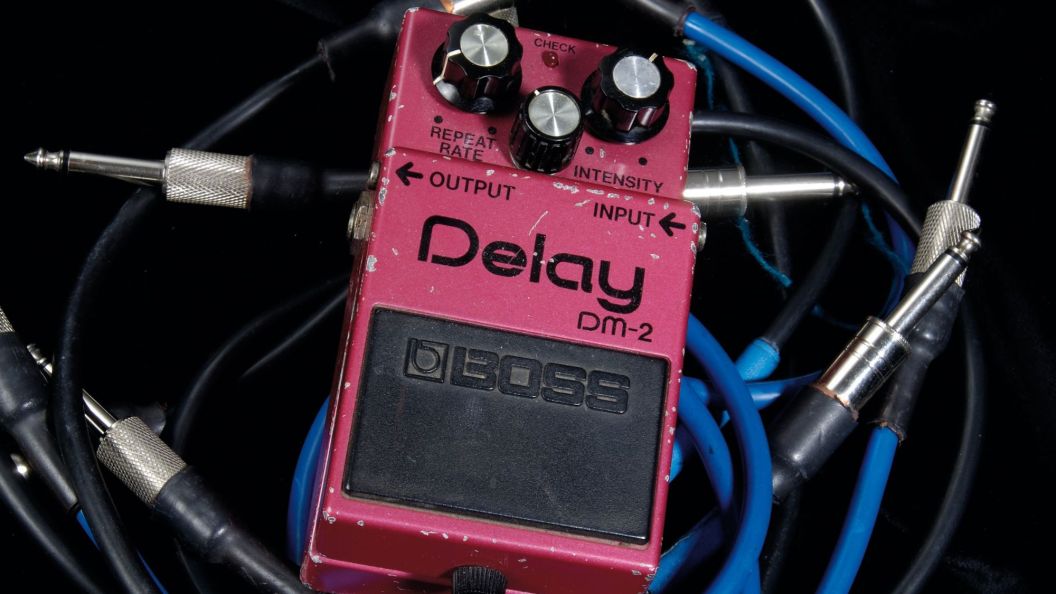
Released in 1982, the Boss DM-2 was a groundbreaking achievement in the world of delay and echo. Guitarists have been using the effect since the 1950s; however, the devices used to make it were often large, complicated, and fragile. Products like the Echoplex used magnetic tape and mechanically sent it through a series of playback heads to create the effect. The Boss DM-2 achieved this through analog circuitry and was the first to do so in a compact footprint.
The DM-2 has origins in the Roland RE-201 Space Echo, which was a mechanical tape echo unit. In 1977, Boss released their first analog delay, the DM-1, as a more affordable, compact alternative. Proving more rugged and reliable than its tape predecessors, the DM-1 still had its issues. It was large in size and was hardwired with an AC power cable.
More compact and capable of being powered with a 9-volt battery, the DM-2 made delay accessible. It became famous for its warm, rich sound thanks to its use of bucket brigade delay chips. 80s tracks that used this iconic pedal were “She Sells Sanctuary” by The Cure, “Invisible Sun” by The Police, and “Don’t You (Forget About Me)” by Simple Minds.
Closing Thoughts
By the time the 80s arrived, guitar pedals were everywhere. Pushing music forward and inspiring players with the push of a switch, these four were merely a drop in the sea of options available. Although many never made it out of the decade, the Boss CE-2, Ibanez TS9 Tube Screamer, ProCo RAT, and Boss DM-2 Delay are still being made. Decades later, they continue to influence and push music forward just as they did decades ago.
Photo by Guitarist Magazine/Future via Getty Images
The post 4 Iconic Guitar Pedals That Shaped the Sound of the 1980s appeared first on American Songwriter.